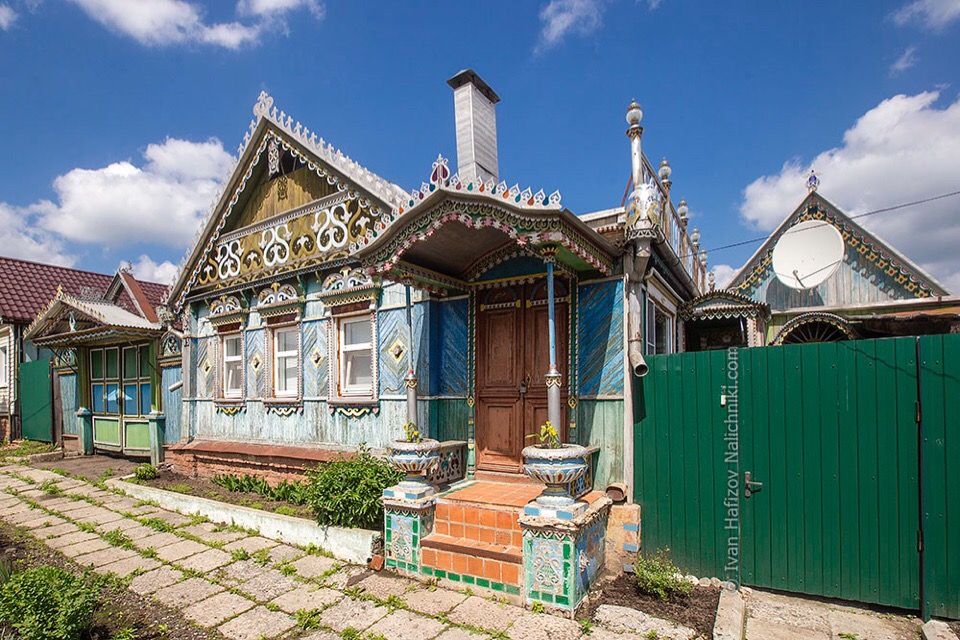
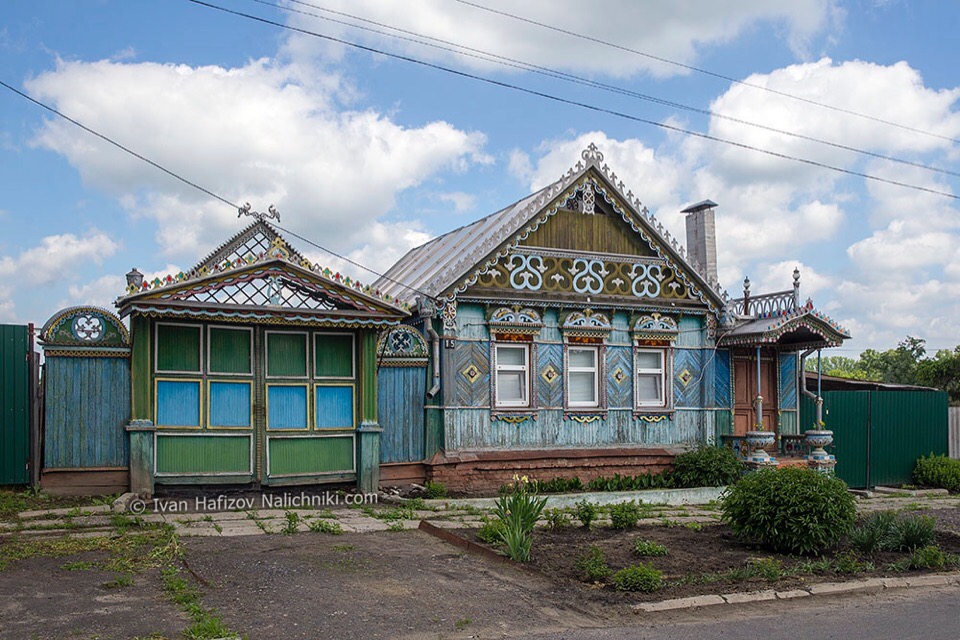
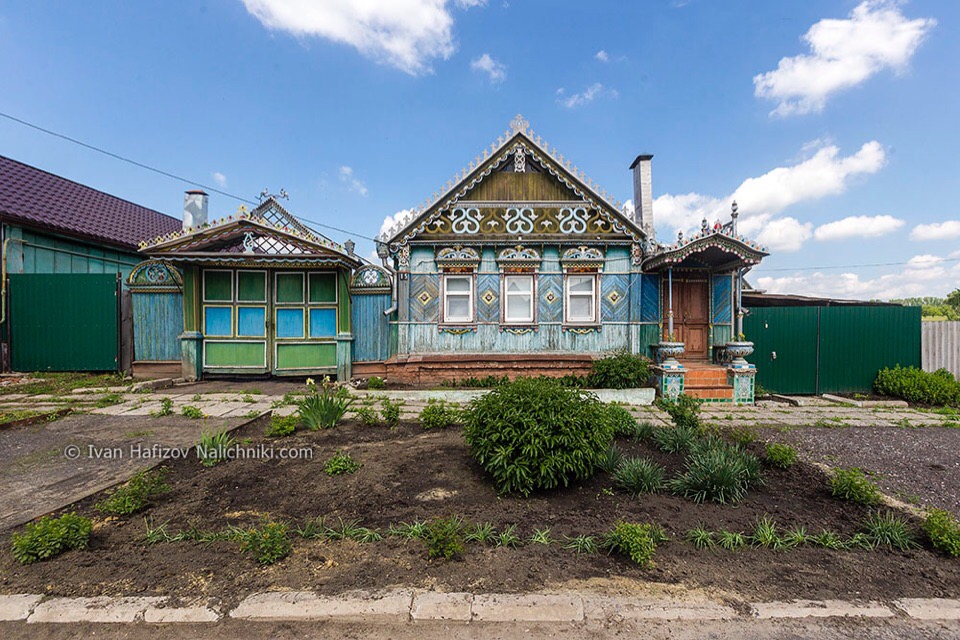
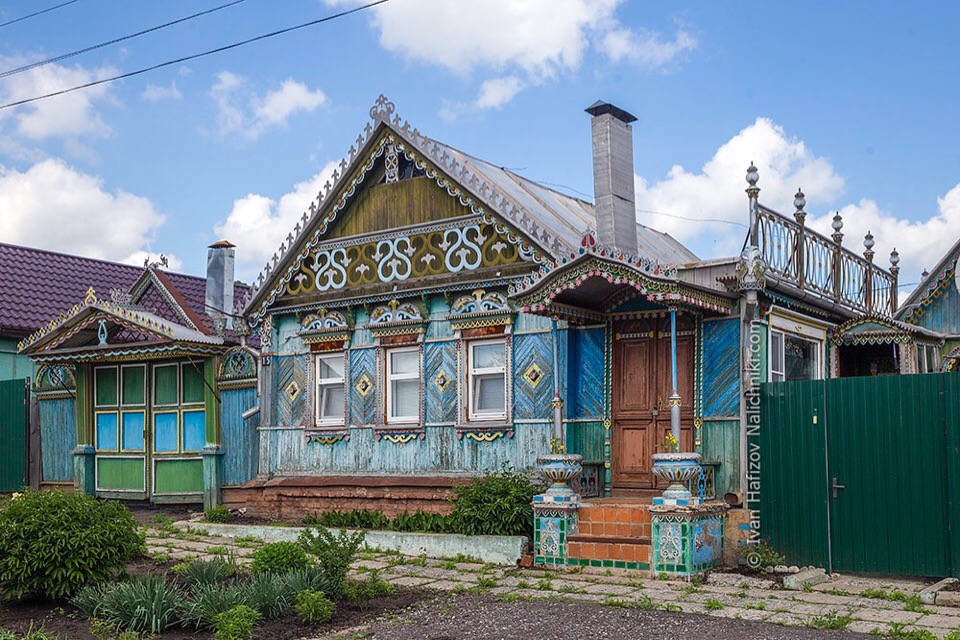
…Driving north from Belgorod region into Kursk, you can't help noticing how the number of log houses increases: the southern steppes were never friendly to wooden architecture. I stop in Fatezh not really because I'm hoping to find nalichniki here, but simply because I wrote it down in my plans five years ago — made myself a promise, and now I'm making good on it. A flat little town; Quiet Street, Peaceful Street, Well Street, Meadow Street… Nothing interesting anywhere… But then suddenly on Nikitskaya Street my heart leaps and my breath catches. I kill the engine, click the cameras in, and run out toward the carved house, not trusting my eyes.
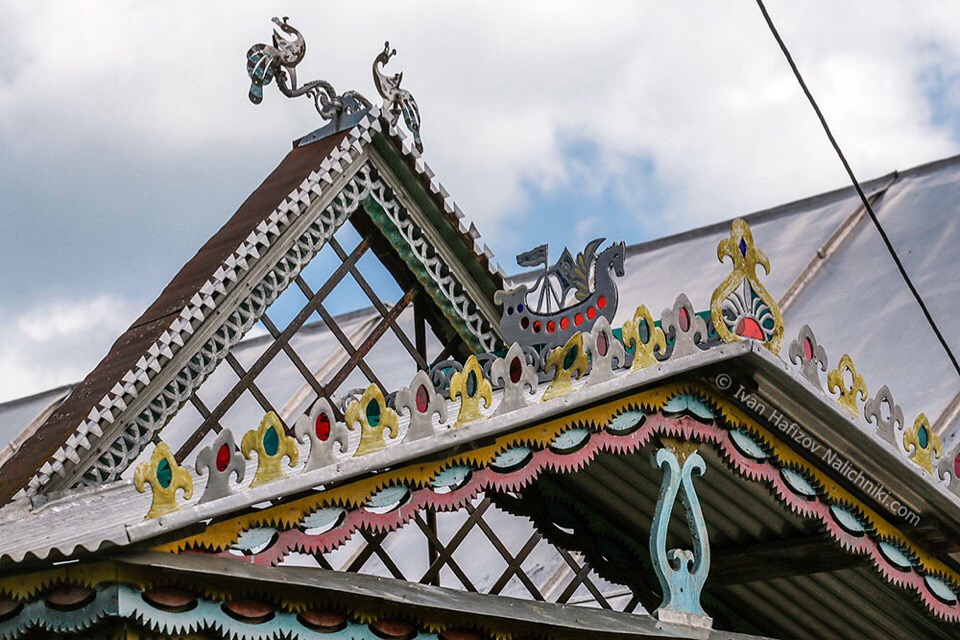
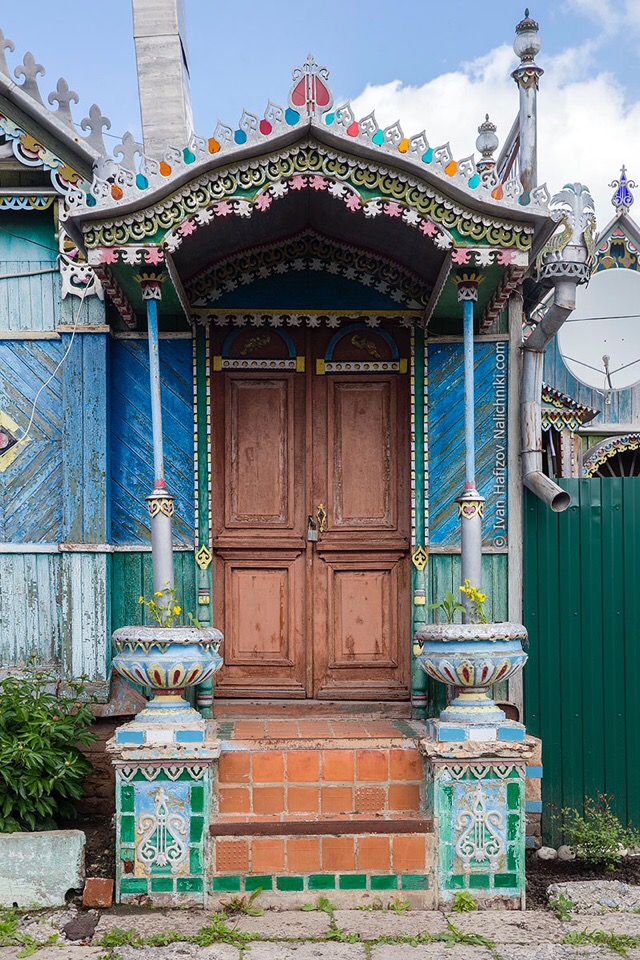
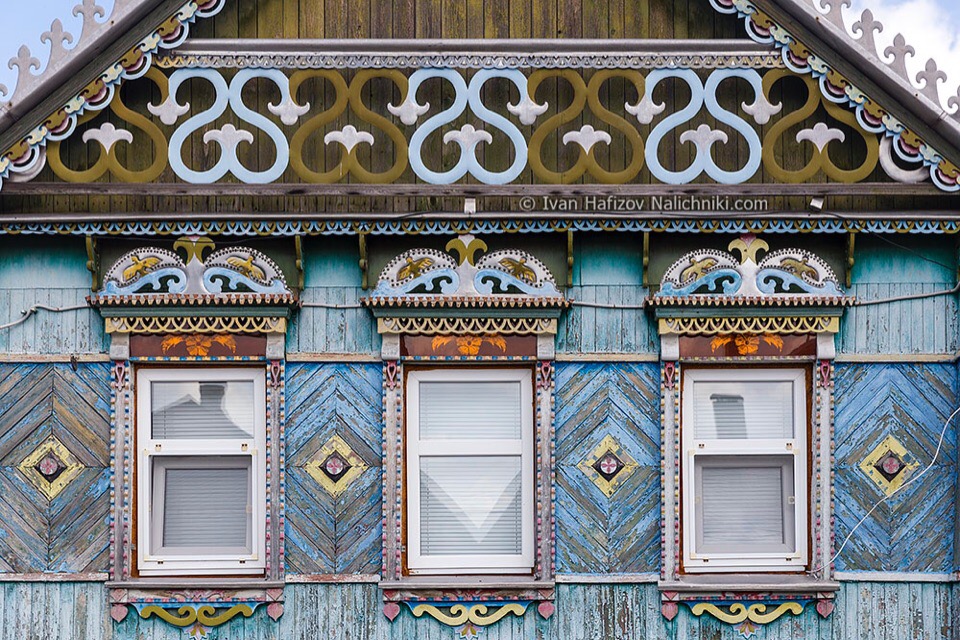
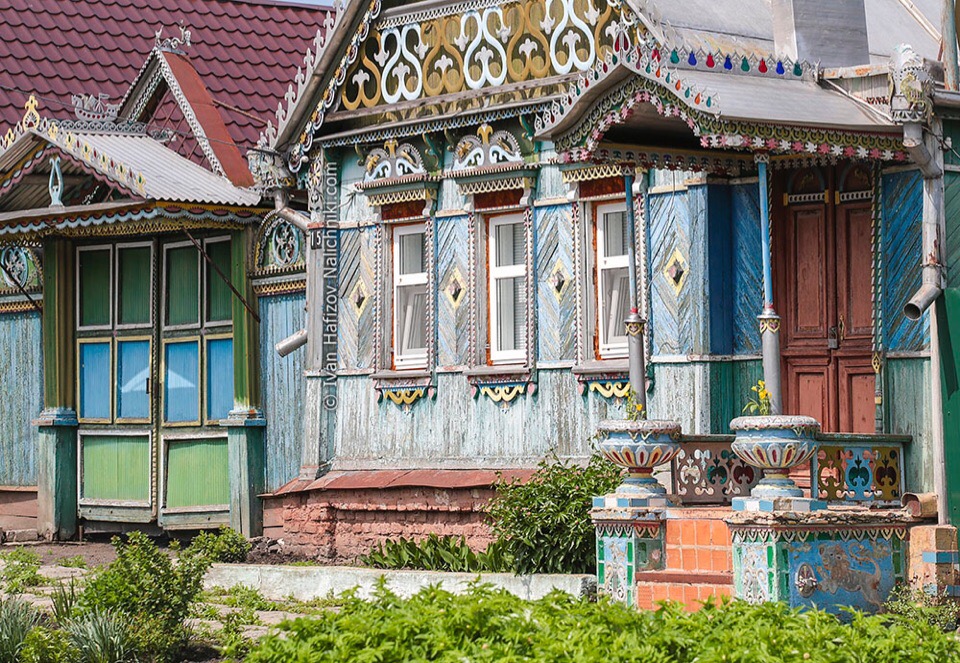
And rightly so: there's almost no woodcarving here either — just a little on the nalichniki, and the same on the porch. But the main ornamentation is all metal!
An elderly woman from the gate of the house across the street watches my series of athletic maneuvers — standard before any carved house — with puzzlement.
— What are you doing? — She comes over, eyeing the cameras suspiciously.
— What an incredible house you have here! — I get excited. — How old is it?
— Sixty years, or even more…
She watches with suspicion, but I choose not to notice: after all, who but a neighbor knows everything!
— And who lives there? — I ask.
— Well, they've all passed on… — she makes a vague circular gesture with her wrist and begins her story. — A daughter and son live here in Fatezh. — And what got you so interested? — suspicion reasserts itself again.
I smile as broadly as I can — the more so since I have no business cards or postcards with me anymore, they ran out on the road.
— Well, I was driving past, I see a house like this!
But she's not so easily misled:
— And where are you coming from?
— From Belgorod region! And on to Moscow.
— What were you doing in Belgorod region?
— Business trip.
— But there was rain there, they said on the forecast?
For a second I don't understand what she means, but following her gaze I realize she's looking at my fairly clean car — which has, I should say, held onto its cleanliness since a wash back in Smolensk, roughly a thousand kilometers back, by no less than a miracle.
— They got it wrong, as usual! — I wave it off. — And what was the name of the carver who made all this?
Now it's her turn to look at me in confusion at the change of subject, but I point at the house and her gaze, I think, warms slightly:
— Oh… no… I can't quite remember his name… They lived here… The grandmother probably died at eighty-three, and the daughter… the daughter lives somewhere outside of town… So that's…
— And the one who did the carving — it was a man, I assume?
— Well yes! — she nods with importance.
— Is he dead too?
— Long ago! Long ago he died!
— And did you know him?
— I knew him. I knew him. — She answers slowly, drawing out her words, and the contrast with her earlier clipped phrases couldn't be more striking — these come out almost in a chant. — I knew him. But I don't remember now… I don't remember anymore. We'd just moved here, and then… About four or five years later, he finished all of this — and died. Right mid-stride. Mid-stride…
— What do you mean, mid-stride?
— Well… He went out to the garden and passed away. Probably his heart. And then his wife… About three or four years later, she died too…
The woman falls silent, looking at the extraordinary house alongside me. I remember I haven't asked something important:
— And the man who did the carving — was he a craftsman somewhere by trade, do you know?
— Well, he was an ordinary man — he worked as… what was his trade? — she asks herself, pausing, staring into the distance. — A craftsman at this sort of thing, — she finishes at last, nodding toward the house.
— A tinsmith, perhaps?
— Well yes, something like that… It was just what he wanted to do. He'd seen something somewhere… He'd look at things and do it himself…
— And at his day job — was he also in metalwork?
— No, he was a watchman — and he helped people too, helped his daughter as well… — she explains vaguely. — His son is still alive, and the daughter and son are both alive…
Then all of a sudden, suspicion is back:
— You mean you only saw it this year?
— More than that — this is my first time seeing it! — I wave my hands.
— And how long have you been here? — she presses on, as if the earlier conversation hadn't happened.
— I'm not here at all — I'm just passing through from Belgorod to Moscow, I drove through town on a whim and noticed it! — I explain once more, trying to make it convincing.
And apparently successfully, because this time her wariness vanishes as suddenly as it appeared:
— Well, they haven't painted it in a long time, haven't done anything to it… Years, decades. At least twenty years for sure… And the current owners don't live in it. They bought it. New owners. Bought it, left everything as is, even a lock hanging on the porch there.
— So the heirs sold it and other people bought it? — I try to navigate her explanations.
— Yes. Well… As they say… The windows, the frames, those are all new, modern… But otherwise it's beautiful of course… I don't know if the girls will paint it or what… They bought this house, about two years ago now. About two or three. They're locals, from Fatezh. The husband works somewhere fixing cars. And the wife works in a shop somewhere…
— And do they appreciate the carving? Or why did they choose this house, do you know?
— Well I don't know… I don't know… Anyway, the original owners have all been gone for ages, nobody left, but the son and daughter weren't so interested. It hasn't been painted for twenty years, probably… But the important thing is that everything here is carved, all beautiful, all of it… Have you photographed it, or have you already?
And then, without pause, staring hard at me:
— What region is your license plate?
— My region? — I think for a second, then laugh as I realize she's at it again — — Moscow region! 50, 150, and 750 are all Moscow region.
— And how did you happen to come through Fatezh? — she won't let up. — And not even down Lenina Street, the main one…
But I know the trick by now:
— I was actually going to ask — are there any other houses like this in Fatezh?
— No. — She switches completely. — This is the only one. It's been photographed plenty! It was in the paper once. Long ago…
— What was the occasion?
— The Fatezh paper. Well, they photographed it, because it was beautiful… And they came and gave a prize… Money or something… For making it beautiful. He did it all himself. He had a son, a daughter… They're both alive, but the new owners have had it two or three years now.
— And how old would the son and daughter be now? — I ask, surprising myself.
For some reason I'd assumed they were around forty, and the neighbor's answer takes me aback:
— Well, around seventy… Roughly. I'm seventy-five, so about the same… They're alive. I don't know what street they live on. And all this beauty remained… Beautiful, of course. He made all of it with his own hands.
— So, — I do the mental arithmetic on the carver's age, — he must have been a war veteran, probably?
— No, no, he was a worker… He was just interested in it, wanted to do this… I've never seen another house like this one, so…
— And why do you think he made it from metal? — I ask. — Usually people decorate houses in wood!
— Well, he… metal… of course I know! Because it lasts forever… That's forever. And the house… the house is small… A kitchen, then this room… then a bedroom there, one little room… The new owners put in local heating… so it's just… Because it lasts forever, you see… So there's that kind of beauty here…
— What was his name, again? Did you remember? — I ask.
— Vasily Petrovich! The surname I don't remember… All this beauty here for how many years now… He did it all on his own… They lived four of them, then the daughter married, and the son sold the house about three or four years ago… Well, it's a good thing you're interested… such beauty is worth photographing… beautiful it is, yes, with all this — with all of it…