
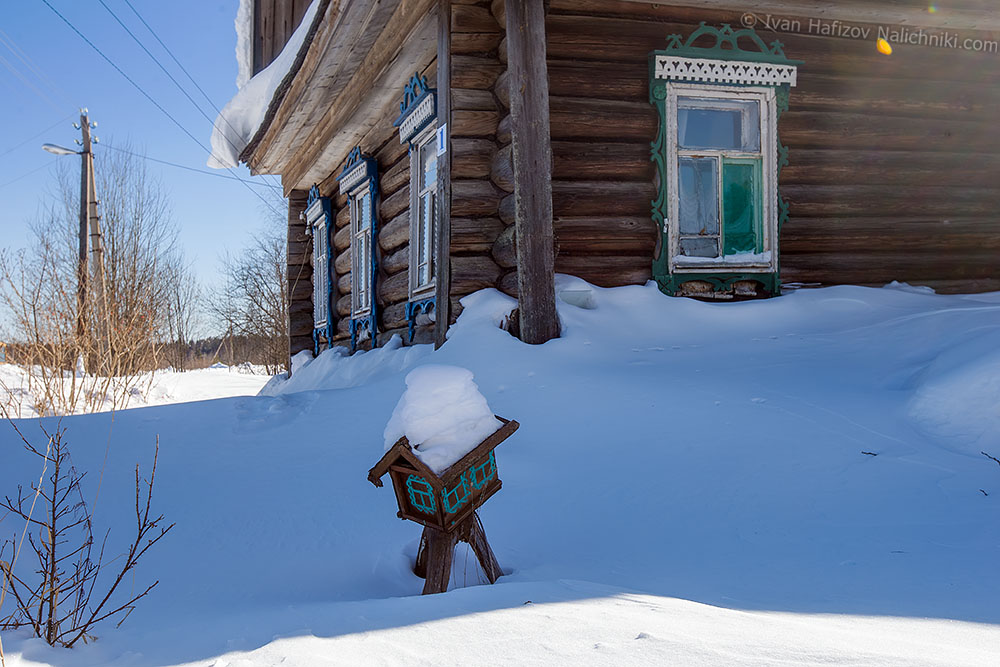
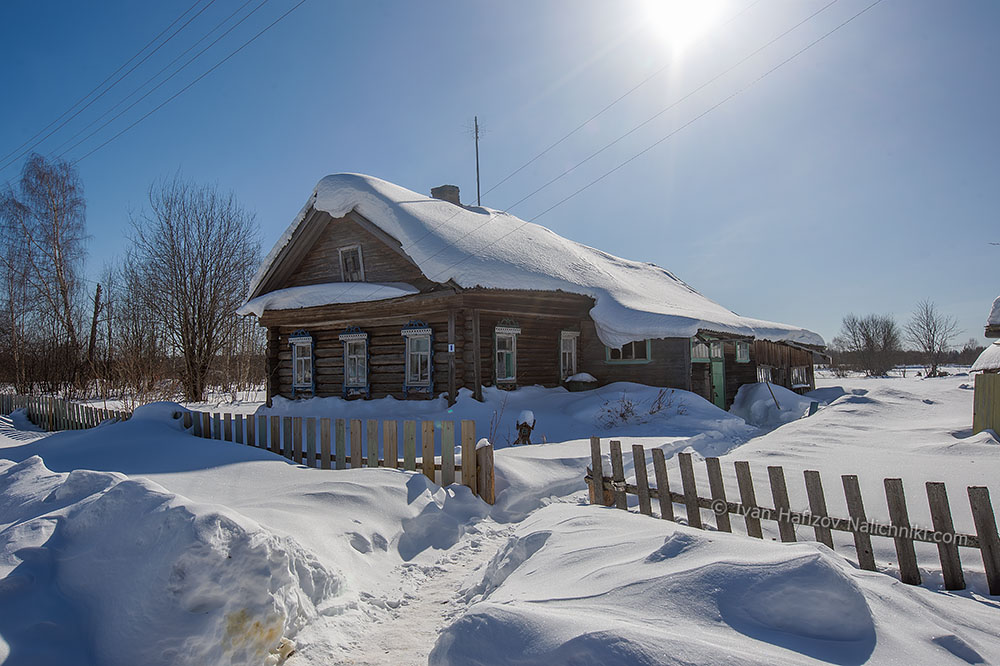
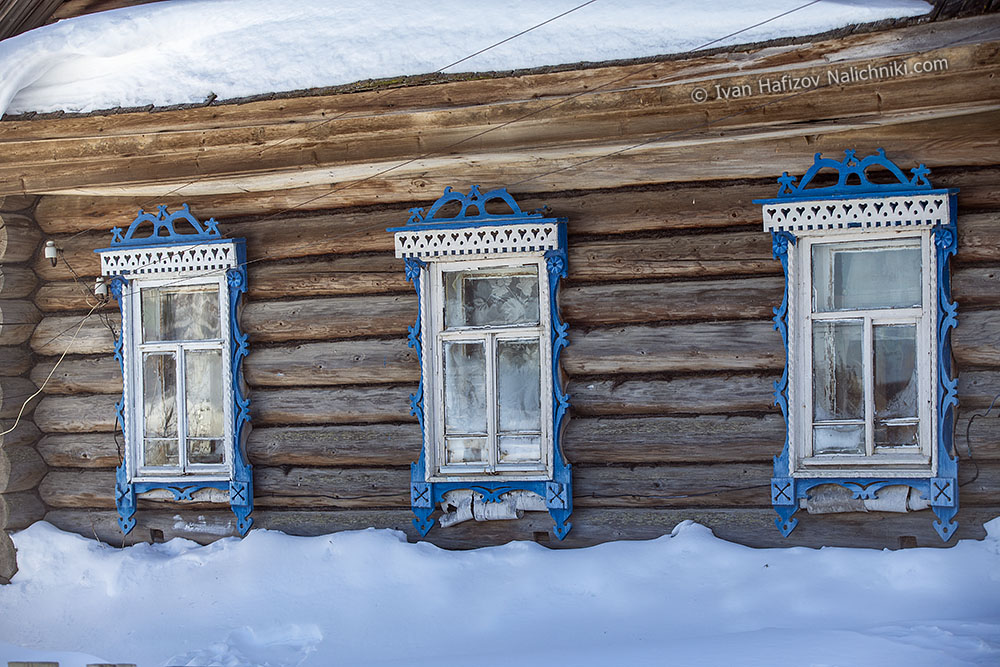
...— So you need Alexander? He's not here — come along, I'll, er... take you. Only he... Doesn't carve nalichniki... Nalichniki — you know where that is? Before Kologriv, Sukhoverkhovo — that's where you want to go. Ask the Kologriv people. The first village before the bridge.
— And Alexander? — I can't make out.
— He does this... — my new acquaintance spreads his hands — ...everything. He carves everything. Anything you like. Nalichniki, no-no... He's purely... woodwork. Ancient stuff! Can tell you how to make pitch. Films of his... — he speaks in staccato bursts, one thought after another, as if they keep interrupting each other. — He was on television, on Russia's channel, Kostroma GTRK. Kostroma. The Russian Geographic Society visited him just last year. They flew a quadrocopter here, and he gave me a photograph of our Chermenino from above. I escorted them on the boat up the river...
For a while we walk in silence, crunching through the snow, releasing little clouds of breath to the sky with every step. Frost close to minus twenty and three days of snowfall keep you on your guard: the road has been smoothed flat by the belly of some large vehicle, but no one, it seems, has yet walked along it on foot.
— He's got... Things he's made... You saw them in the Kologriv museum, presumably? All his pieces are there, worth quite a considerable sum...
— Didn't see it. They had no electricity there for four days, — I say with regret.
— Ah... All his things are there. Starting from the last period he made owls. He can explain every little curl, tell you about it.
And we fall silent again. I thought we'd walk side by side, but the road leads out to a field and in a wide arc heads away to the right somewhere beyond a brick building with an enormous satellite dish on the roof. Some village, I think.
— What do you do yourself? — I suddenly decide to ask.
— I'm retired, — he answers, somewhat grudgingly, after a moment's thought. — But right now I work here. Former school. The Kologriv residential home for the elderly and disabled.
— Residential home? — I'm surprised. — I thought it might be something military... And why the enormous dish? — you don't often see a six-meter satellite dish on a former school building out in the countryside.
— That? — He shrugs, looking at me as if I don't know the obvious. — That's for Channel One. First program.
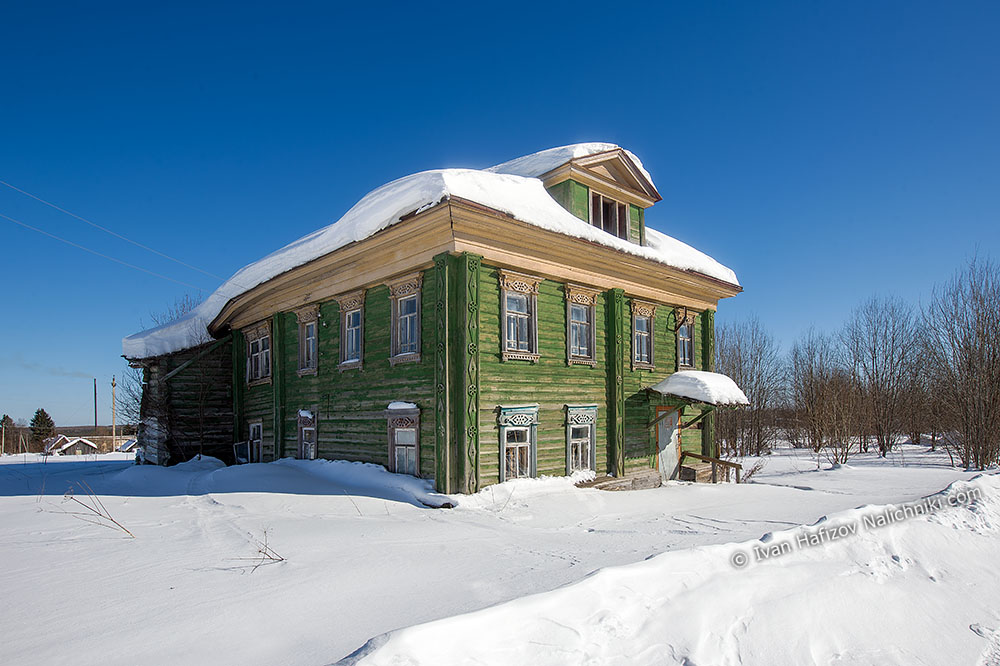
We come out to a two-storey wooden mansion, and catching my interested glance, my guide explains:
— Village council. Former. Medical post and library were here too. Then once the whole business of collapsing rural things began... It could have been restored, could have been a cultural center — would have been enough for the village... But now... And there's the club, too. — He nods toward another large wooden building with a caved-in roof.
— Merchant mansions, these must be?
— I can't really say... When I finished school I went to defend the motherland. For twenty-two years.
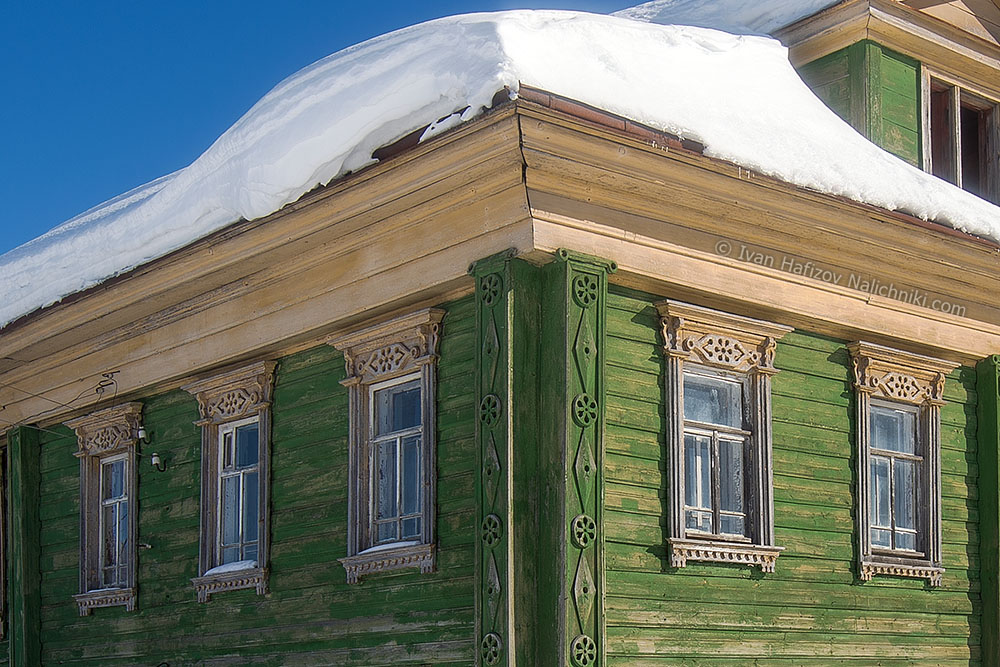
In the middle of all that snow, under that impossibly deep and saturated sky, the abandoned wooden mansions, lightly adorned with carving, look like ships that have put in to our time from the pages of some old book — with its large decorative initials, yellowed pages, and a hand-made cover, slightly torn, held together with cheesecloth. You can almost hear them creaking as they drift through the frozen silence.
— How many people live in the village? — I ask, just to break the spell.
— Twenty-something. Plenty of people before. When the student work brigades came from Kostroma, you couldn't push your way through the club. You should come in summer — from the river you can see all the erosion. There's the... Old Kologriv, if you float down the river you can see it. From the road it's all overgrown, but from the river it's visible. Now everything's grown over. Even the cemetery... You'd need a tracked tractor... Further along there's a logging settlement. But now, I don't know, probably everyone's moved away already. Maybe one person left. It's all become like an abandoned place. Life used to be humming here. They used to float timber down the river, there were fish, steamboats ran, barges put in. And now in summer... You can wade across it anywhere. I have a flat-bottomed boat, you ride along and the bottom just drags. But all that ended under Soviet power. And now everything's... — he sighs and waves his hand — ...all grown over. Can't even get to the river anywhere — not with a fishing rod, not with anything...
At last we reach the carver's house and knock.
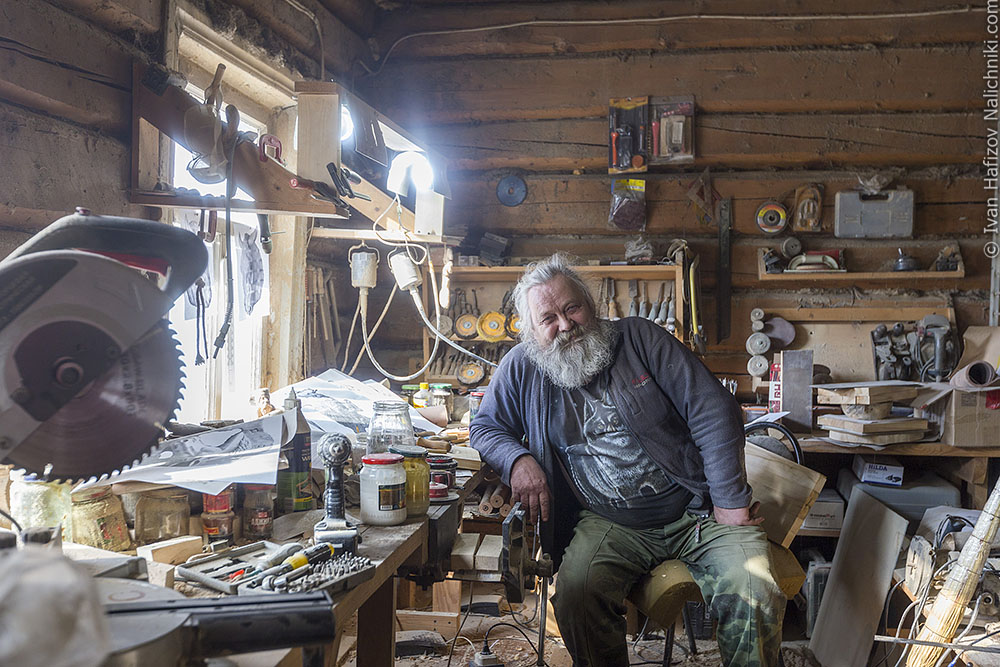
— Alexander Vladimirovich — there are visitors for you, — announces my guide when the door opens and on the threshold appears a stocky bearded man with a sly look in his eye. — From Moscow, interested in things. I told them we have here the most famous woodcarver in almost all of Russia. To have a talk... As you told it on television. As a professional. Will you show them?
Alexander looks at us in surprise, squints, finally draws out:
— Three-litre, that's my opening offer.
— Go to hell! — our escort laughs, already turning to leave — this man who in a matter of minutes has become like an old friend.
— All right, I'll take one litre! — adds Alexander, flinging the door wide in invitation. — But in three copies!
While my eyes adjust to the dim entrance hall, Alexander, creaking a floorboard, has already disappeared into the darkness of the corridor.
— Put the hook on. And we don't take our shoes off here.
— Why the hook? — I'm puzzled. — Do strangers come in?
— The thing is... Not everyone around here is working people. — he turns back to check I follow. — There are working folk, and then there are those who are "at it." Well, that's how it is... And what do you do?
— I study nalichniki. My name's Ivan.
— Hell... You know where you really need to get to? — Alexander stops right on the workshop threshold. — Ppp... hell... what's it called... Past Kologriv, that way... toward Manturovo... Pereversevo, maybe?
We pass into the workshop; Alexander throws his arms wide to show off his domain.
— Normally, I prefer it, you know — if people ring ahead, I'd at least have tea ready, for starters!
— Well, that's all right, it's not the main thing, — I try to say, but the master suddenly turns firm:
— No, actually, wait! Go to my VKontakte, I'll give you the link, watch the video. I have a tea "from the Forest Spirit." I have tea from the Forest Spirit! You can only get that kind of tea at my place — because nobody else makes it. And the main thing: it's different every year.
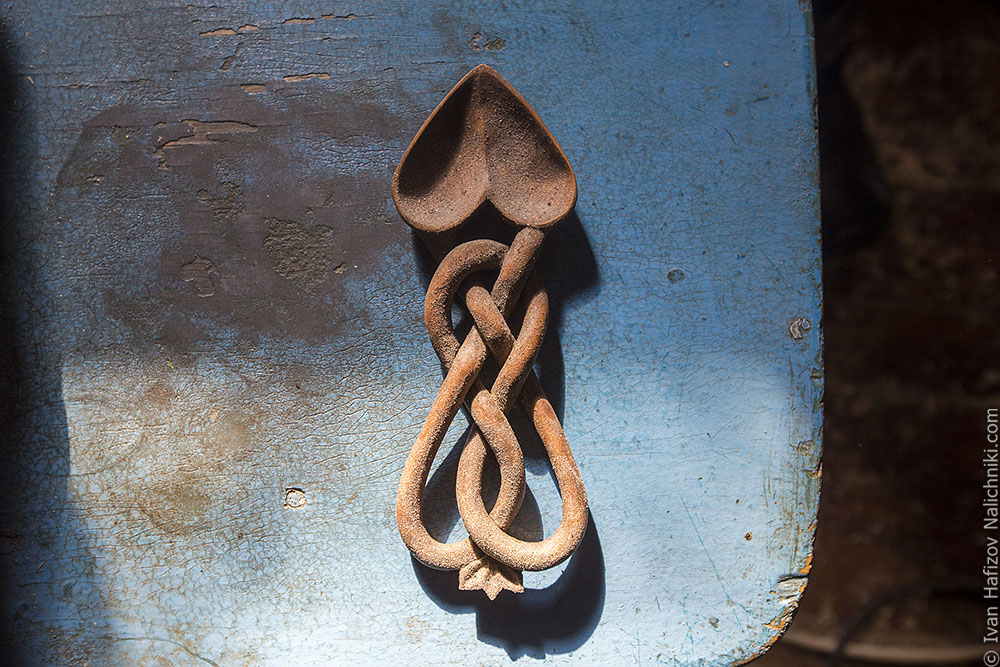
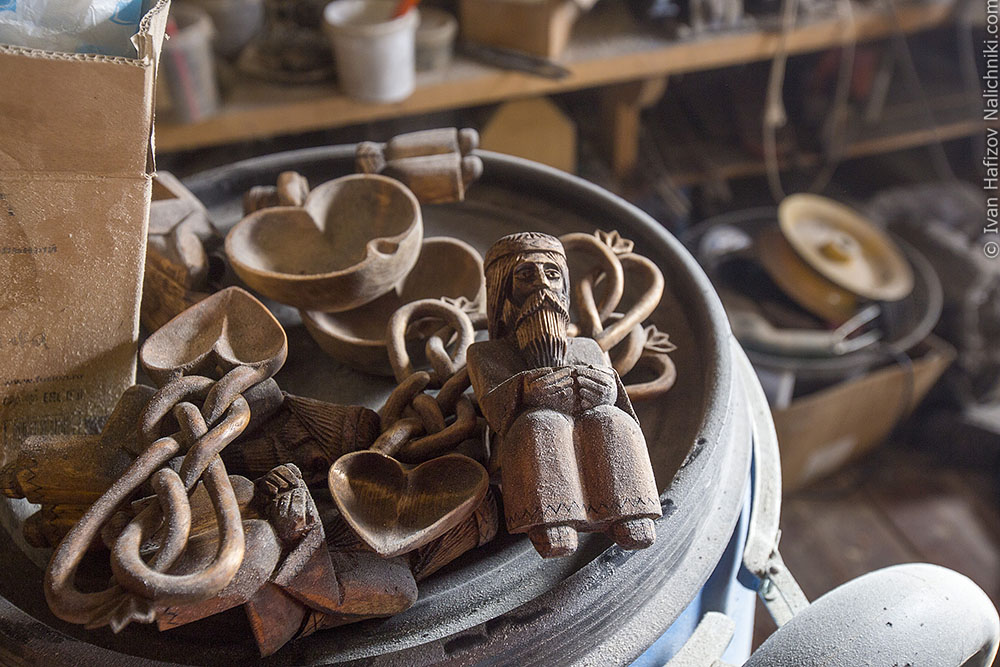
He shows us his work, talks about wedding twisted spoons, the revival of genuine old traditions, the new barn where every piece of wood dries for three years before being put to use... About nalichniki from the fifties that somehow echo an iconostasis from nearly the eighth century... Alexander talks warmly, in a kind of creak, getting up sometimes to show this or that piece, but more often just gesturing broadly toward whatever he's describing... About his apprentices, who (mostly girls, for some reason) come to him from the capitals and make the twisted spoon, but "not a single one of the lot, in seven years, has made so much as one spoon at home!"
I ask about the wooden House of Culture built in the thirties somewhere in the Manturovsky district, and Alexander suddenly falls to thinking, remembers something else:
— I'll tell you this... That would be the Vytegra district, Annensky Most, I think there's one there. There's a House of Culture in the forest there. Let me tell you about this house. What's interesting about it. It's a two-storey house. Built by two people, husband and wife. In the forest. They were dekulakised after the Revolution. Sent into exile. They served their exile... Came back. Settled in the forest. Deep in it.
— And that was already after the Revolution?
— Well, of course. They were dekulakised after the Revolution, sent to Siberia, did their time there. So they came back — and listen, here's the whole point of it! They built a two-storey house in the forest, the two of them alone. A woman and a man, built it. Then in the early sixties they were dekulakised again. Some geologists stumbled onto them by accident. Going through the forest: a path, where cattle had walked. They followed the path and came out — a cattle yard. In the forest! Well, they went back and reported it, and then the whole business, everything taken away, as they say. But the wife used to go out from time to time. Sell some butter and cream, buy salt, whatever was needed, and go back. That's how they lived in the forest — deep in it, no bother, nothing. Entirely off their own. Their own potatoes, their own sown field. Their own bread. Think of it! Just the two of them. No children. They had: a horse, two mares. Five cows. A whole flock of sheep. Imagine. Chickens and ducks, that's already... They sowed everything themselves, harvested it themselves... Potatoes and everything else. Took no power from the state, nothing... People just lived, you understand! And in the early sixties they were dekulakised a second time. And that house is still standing there in the forest. A two-storey house! A great big house!
— And how do you find it?
— Well, you'd have to find the information. Someone must take people there. Whether you can drive in or not, I don't know... Something like the Petrine Canals, they're called, are somewhere around there...
For a moment we go quiet: I'm writing into my phone everything I can remember; Alexander, noticing this, gives me a pause.
— By the way, — he continues — listen, in my own lifetime, I witnessed living history! How old was I... Seven, I think... Seven or eight. We had weekend excursions. Right. From the museum. A bus left and took us, the schoolchildren. Summer holidays, you see, they take us out. The excursion was called "Living History." Well, off we went to see living history. Three old women. Something like two metres tall. Tall, thin! One, as they say, past a hundred, and two past ninety each. Mother and two daughters. Think of it: when I was eight years old, she was a hundred-and-something. So she had lived under serfdom! She was about ten when serfdom was abolished. And she... got married, had two children, and her husband was taken as a recruit for twenty-five years. He never came back...
Alexander pauses — not to catch his breath, but for effect. He is a good storyteller; you could listen for hours. I've long noticed that people in the country spend far more time in conversation. They retell the past, again and again, from past into future... Time itself seems more human in the village: it bogs down here and moves differently. Sometimes it stops, holding on to a gate, shifting from foot to foot; sometimes it freezes, seeming to ask whether you've understood or should it go over it again...
Alexander continues:
— I'd have forgotten the whole thing, but it was the first time — still a little Octobrist, mind you! — first time I'd ever heard anything unflattering said about Soviet power. She said it plain: under serfdom people lived better. Laborers lived better, under the kulaks people lived better, than under Soviet power. Right out, to your face, the old woman! What did she have to lose — nothing to lose! But the funniest part, the thing that fixed it in my memory — we came to the river. Haymaking, summertime. And where did they hand out the plots? Where machinery couldn't go. So these three old women were given island plots. All three of them pensioners. And they give them the haymaking on islands! Well, we came up — two boats, side by side. Little flat-bottoms. And what was also interesting: she was the one doing all the talking; the daughters never said a word. The eldest talks, the younger ones say nothing. So. They throw the tools into the second boat, sit down. She's got a "Vikhr" outboard on hers... You know, it starts on the first pull. The daughters sit in front, she's in the back — yank! Starts first time, she casts off full throttle, the flat-bottom rears up on its stern and off she went! You should have seen it! A hundred-and-something-year-old woman! And how we went chasing after them in these little hops! They're tall, one stride of theirs — and we were small! — he trails off.
— Well, so, as they say, that's when I first heard anything critical about Soviet power. From a pure outside perspective...


